Ongoing geopolitical conflict often raises questions about how current events may affect long-term investment outcomes. While markets can react sharply to uncertainty in the moment, the relationship between global crises and long-term equity market returns is often misunderstood.
Examining how geopolitical conflicts have historically affected long-term equity market returns can help distinguish temporary volatility from changes that may matter for long-term planning. We believe this historical perspective can be especially valuable when headlines are dominated by global tensions and short-term market movements.
Key Takeaways
- Geopolitical conflict has historically contributed to short-term market volatility but has not consistently altered long-term market growth.
- On average, the S&P 500 has maintained a long-term upward trajectory for nearly a century of global events.
- Historically, markets have often produced positive returns in the year following major geopolitical disruptions, though outcomes vary.
- We believe these examples highlight the importance of maintaining discipline during periods of heightened uncertainty.
Market Uncertainty During Geopolitical Events
Periods of geopolitical tension often generate heightened market volatility and investor unease. While current global conflicts may dominate the news cycle and raise concerns about global and U.S. equity markets, historical context helps explain how equity markets have reacted during similar periods of uncertainty.
Market volatility during geopolitical events is not unusual and is often short-lived. Historical data suggests that such events have not typically altered the long-term upward trajectory of equity markets over time. Over time, the economy has shown an ability to adapt and recover following periods of disruptions caused by wars, political crises, and other global shocks.
Over the long run, equity markets have demonstrated a consistent pattern of recovery and advancement. Several key observations to keep in mind:
- Geopolitical conflict often increases market volatility as investors react to uncertainty.
- Current global tensions can appear specifically uncertain, in part due to the pace and intensity of media coverage, which can influence investor confidence.
- History provides perspective. Looking across decades of conflict, markets have often delivered positive returns in the year following a major disruptive event, with the S&P 500 historical performance showing an average one-year forward return of approximately 14%.
- The market has shown resilience over time. The S&P 500 Index has maintained an overall upward trajectory over nearly a century, despite numerous wars and geopolitical crises.
What History Shows: One-Year Returns for Markets After Major Geopolitical Conflicts
Looking at the chart below, the S&P 500’s performance following significant geopolitical conflicts offers additional context. Historical data spanning wars, terrorist attacks, regime changes, and major political crises illustrates the market’s ability to often absorb geopolitical shocks.
While events such as the invasion of Ukraine in 2022 or ongoing conflict in the Middle East have led to short-term volatility, markets have more often generated positive results over the subsequent 12 months. Data extending back to the Korean War shows that the S&P 500 has historically achieved an average one-year forward return of approximately 14.2% following major geopolitical events. These averages include a wide range of individual outcomes, reflecting materially different market responses across a variety of events.
For example, while the market saw a 43.7% return one year after the COVID-19 crash, it experienced a 16.8% decline in the year following the 9/11 terrorist attacks. These varied outcomes underscore that market responses differ by event and context, and that past performance does not guarantee future results.
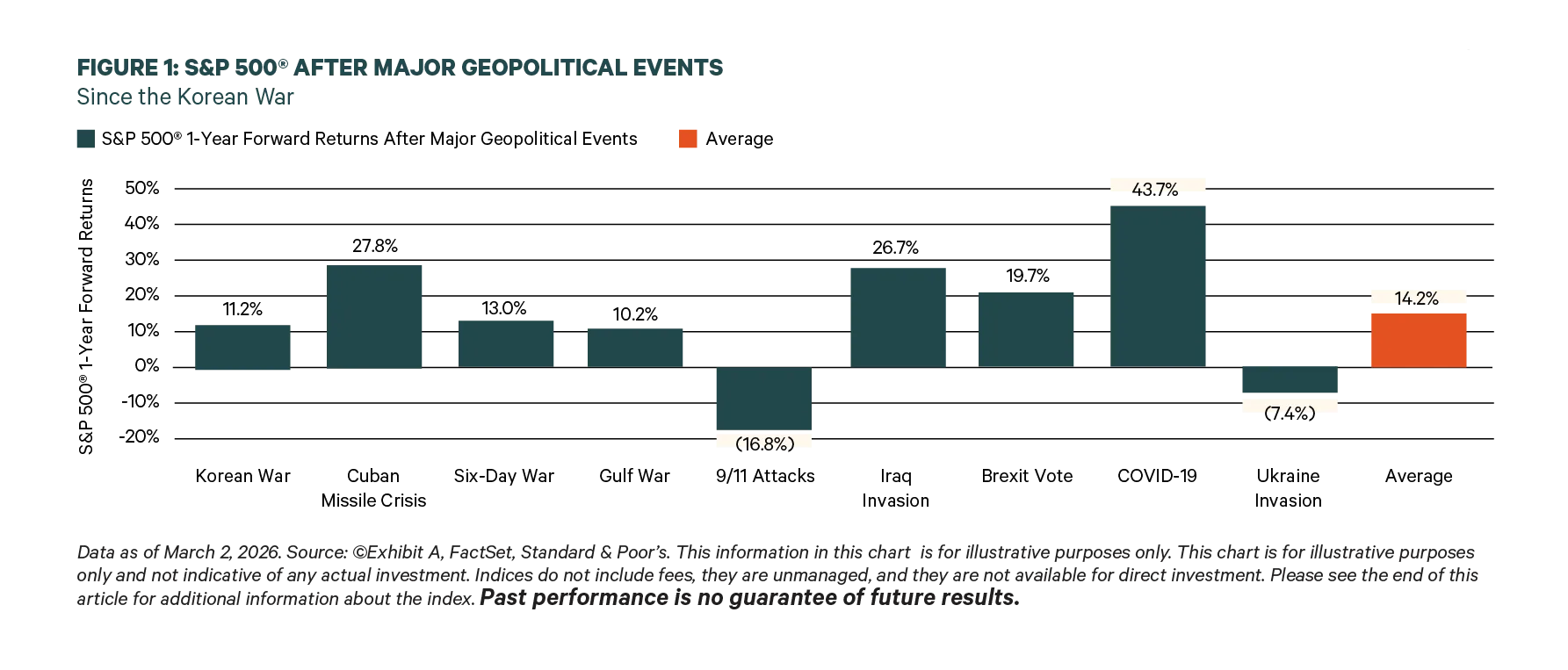
The chart highlights several high-level observations about how markets have responded to geopolitical conflicts:
- Geopolitical conflicts often coincide with periods of heightened market volatility around the time of the event.
- Markets have often generated positive average returns one year after major events, despite initial instability. This has been observed following events such as the Cuban Missile Crisis, the Gulf War, and the Brexit vote.
- Outcomes vary by event, with individual periods showing gains of more than 13% after the Six-Day War in 1967 and losses of nearly 17% following the September 11 terrorist attacks.
- History can provide a useful frame of reference, though it is important to remember that past market behavior is not a guarantee of future results.
A Longer-Term Perspective: Nearly a Century of Global Events
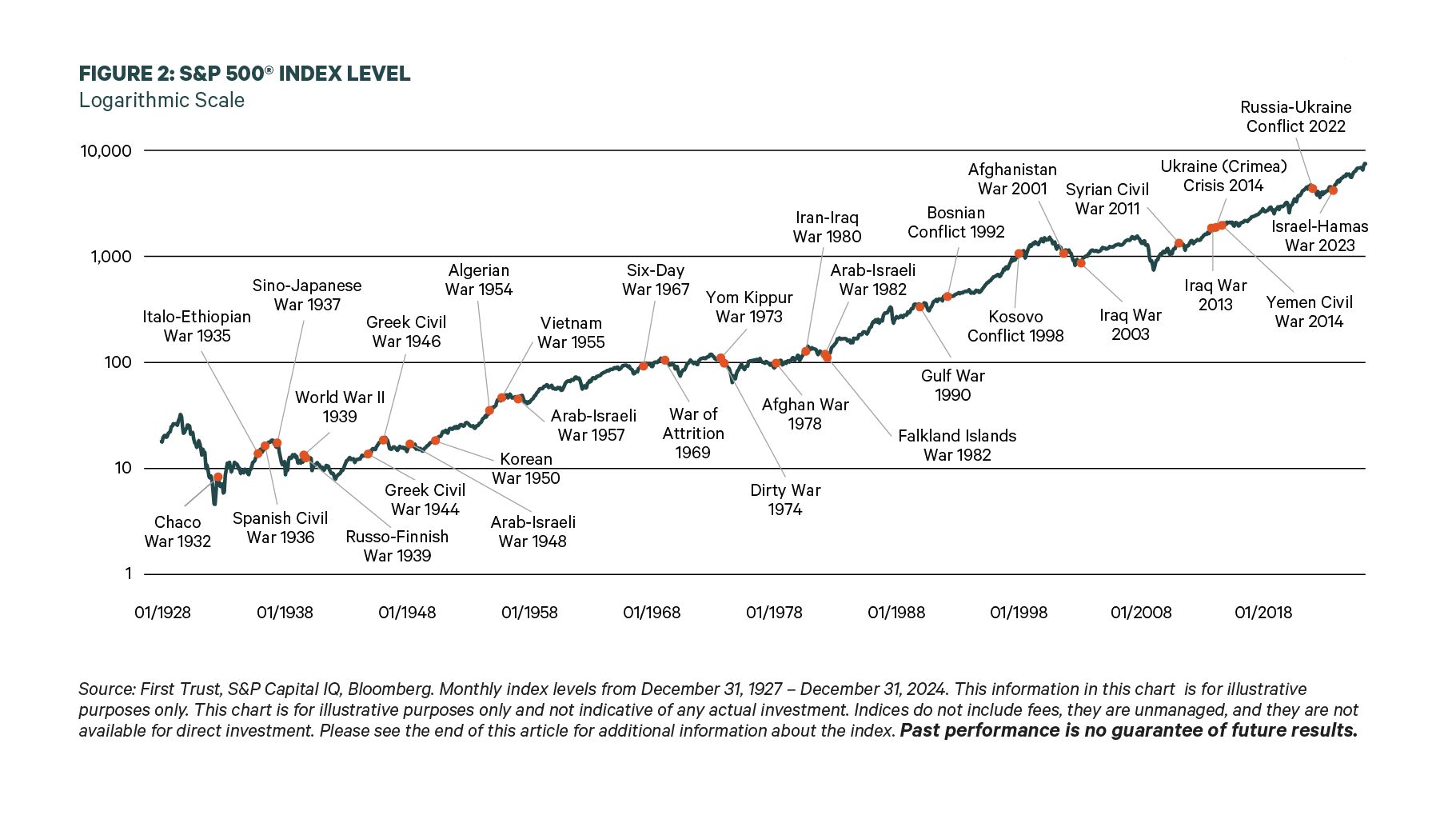
Taking a longer-term view may provide additional clarity. Over nearly a century, the S&P 500 Index has navigated a wide range of global challenges, including world wars, regional conflicts, political upheaval, and economic crises.
While these events have created periods of volatility and uncertainty, longer-term market patterns have been shaped by development over decades rather than individual events. Even during prolonged periods of geopolitical tension, such as the Cold War, or during acute crises like the 1973 oil crisis and the September 11 terrorist attacks, the broader long-term progression of the market remained intact.
More recent conflicts, including the Gulf War, the Russia-Ukraine war, and current tensions in the Middle East, reflect similar patterns that show the market’s longer-term direction remained intact.
As the chart below illustrates, the S&P 500 has progressed through numerous periods of conflict and disruption for close to a century, which we believe reinforces the value of evaluating current events within the context of a long-term plan.
Structural Drivers of Long-Term Equity Returns
In our view, the S&P 500’s upward trajectory over nearly a century reflects the underlying strength of the U.S. economy and the ability of its companies to adapt to a wide range of global challenges, including periods of war and geopolitical conflict. As the market has progressed through numerous disruptions, we have observed several structural factors supporting long-term equity returns:
- The market’s advance through periods of geopolitical stress reflects the ability of companies to generate earnings across changing conditions.
- The sustained upward movement of the S&P 500 from 1928 through 2024 points to repeated cycles of corporate adaptation and recovery across changing conditions.
- The index’s progression through geopolitical conflicts ranging from the Spanish Civil War to the Russia-Ukraine war reflects broader global economic expansion over the last century.
- The market’s longer-term pattern following major disruptions consists of underlying productivity and economic growth over time. Individual outcomes may have varied, but longer term trends have remained intact.
Volatility vs. Permanent Loss: Understanding Market Reactions
Understanding the distinction between volatility and the risk of permanent loss is an important concept for long-term investors during periods of geopolitical conflict. Market volatility during geopolitical events can provoke strong reactions, but not all price movements carry the same implications for long-term outcomes. In our experience, conflating short-term turbulence with lasting damage can increase the risk of decisions that lock in short-term losses. As we see it, taking a historical viewpoint can help explain how a long-term perspective has shaped investor outcomes during these periods:
- Volatility is not always synonymous with long-term investment risk. Sharp market swings can be driven by uncertainty, sentiment, and temporary liquidity pressures, rather than a fundamental deterioration in the earnings power of diversified businesses.
- Sudden moves in the market are often influenced more by sentiment than by fundamentals. Geopolitical events can trigger emotional responses that temporarily disconnect market prices from underlying business values.
- We maintain that temporary drawdowns are often associated with market psychology and liquidity, whereas permanent capital impairment more commonly stems from structural decline, excessive leverage, or being forced to sell at unfavorable prices. From our viewpoint, geopolitical events have historically tended to produce the former for diversified portfolios, while reactive decision-making has increased the latter.
- Attempting to time the market around geopolitical events carries meaningful uncertainty. Reducing exposure to avoid near-term uncertainty volatility requires correctly anticipating both when to exit and when to re-enter, a challenge that has proven difficult even for experienced investors.
- Missing a relatively small number of strong recovery days can materially affect long-term outcomes. Market rebounds often occur unexpectedly and during periods when uncertainty remains elevated, increasing the risk that investors who move to the sidelines are not positioned for those recoveries.
The objective during periods of market volatility related to geopolitical events is not to eliminate exposure to volatility, but to ensure portfolios are constructed with appropriate diversification, risk awareness, and alignment to long-term goals. In this context, we believe the guidance of an experienced wealth advisor can help investors assess positioning and maintain perspective.
Why This Matters for Long-Term Investors
The sections above illustrate how decisions made during periods of volatility can influence long-term plans over time, and for long-term investors, geopolitical uncertainty is a recurring feature of the investment environment.
In our view, investors who maintain well-diversified portfolios and focus on long-term goals rather than short-term headlines have the potential to be better positioned to navigate these periods without compromising their investment objectives. In our experience, maintaining perspective, particularly during times of elevated uncertainty, can help support more deliberate and informed decision-making.
Perspective as a Differentiator
The instinct to treat each new geopolitical conflict as an unprecedented threat is understandable, but we believe history offers a more nuanced view. Markets have repeatedly moved through world wars, oil crises, terrorist attacks, and geopolitical realignments, and long-term equity returns have historically persisted alongside these disruptions. From this standpoint, maintaining perspective means remaining aligned with long-term investment objectives and avoiding reactive decisions driven by short-term market noise.
If you would like to discuss how current geopolitical developments may impact your long-term investment plan, our experienced wealth advisors at Kayne Anderson Rudnick can help provide perspective and review whether your portfolio remains aligned with your personal financial goals.