Emerging markets are reentering investor conversations after more than a decade of underperformance and institutional neglect. Improving macroeconomic conditions, including a shifting U.S. dollar, alongside attractive relative emerging markets valuations and corporate governance reforms across major regions, are creating a stronger backdrop for this often overlooked asset class. However, the most compelling opportunity may not lie in broad index exposure. Instead, we believe a focus on high-quality businesses with durable earnings and sustainable competitive advantages may better capture long-term value when it comes to emerging markets investment opportunities.
Emerging Markets May Be Entering a New Cycle
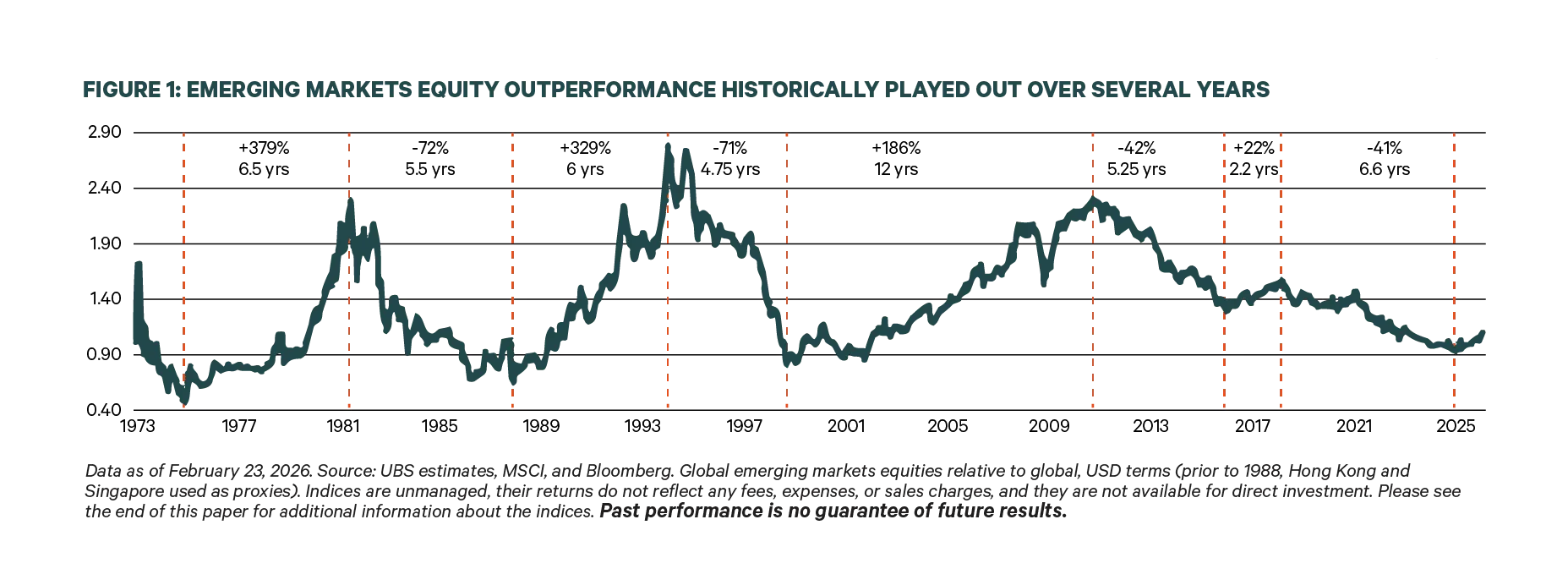
Financial markets are characterized by long periods of shifting between disappointment and recovery with down cycles that can extend for long periods causing even the most patient investors to abandon ship. Emerging markets has, until recently, endured such a cycle. However, there are now signs that the asset class is showing signs of reversal. While emerging markets has outperformed U.S. equities since early 2025, several indicators suggest this trend is still in its early stages rather than being fully realized. Here’s why:
- Cyclicality: Emerging markets have recently endured a decade-long cycle of underperformance and institutional neglect.
- Duration of outperformance: Historical data shows that the outperformance cycles of emerging markets equities are not short-term; they have often lasted for several years.
- Current backdrop: Aligning factors such as a shifting U.S. dollar, corporate governance reforms, and historically low institutional allocations support the potential for a sustained recovery.
Why the U.S. Dollar Matters for Emerging Markets Equities
The value of the U.S. dollar is a primary driver of emerging markets performance, often exhibiting an inverse correlation with the asset class. A strong dollar creates significant headwinds by:
- Attracting foreign capital toward U.S.-based assets
- Depressing local emerging market currencies and valuation
- Increasing financing costs for developing nations
However, this trend may be reversing. Since peaking in 2022, the dollar faces pressures from narrowed yield differentials, expanding U.S. fiscal deficits, and improved fiscal discipline within many emerging market countries.
Governance Improvements Could Strengthen the Case for Emerging Markets
Historically, weak corporate governance has posed a significant challenge for investment opportunities in emerging markets. Key concerns have included the subordination of minority shareholders to state interests or controlling families and value-destructive capital allocation, particularly through excessive equity issuance.
However, current reform efforts in countries such as China, South Korea, and India are shifting this dynamic. Regulators are now incentivizing better disclosure and shareholder engagement while curbing share issuance. While these improvements “raise the floor,” we maintain that careful, active management remains essential to distinguish between truly well-governed businesses when evaluating opportunities in emerging markets.
Emerging Markets Valuations Still Look Compelling
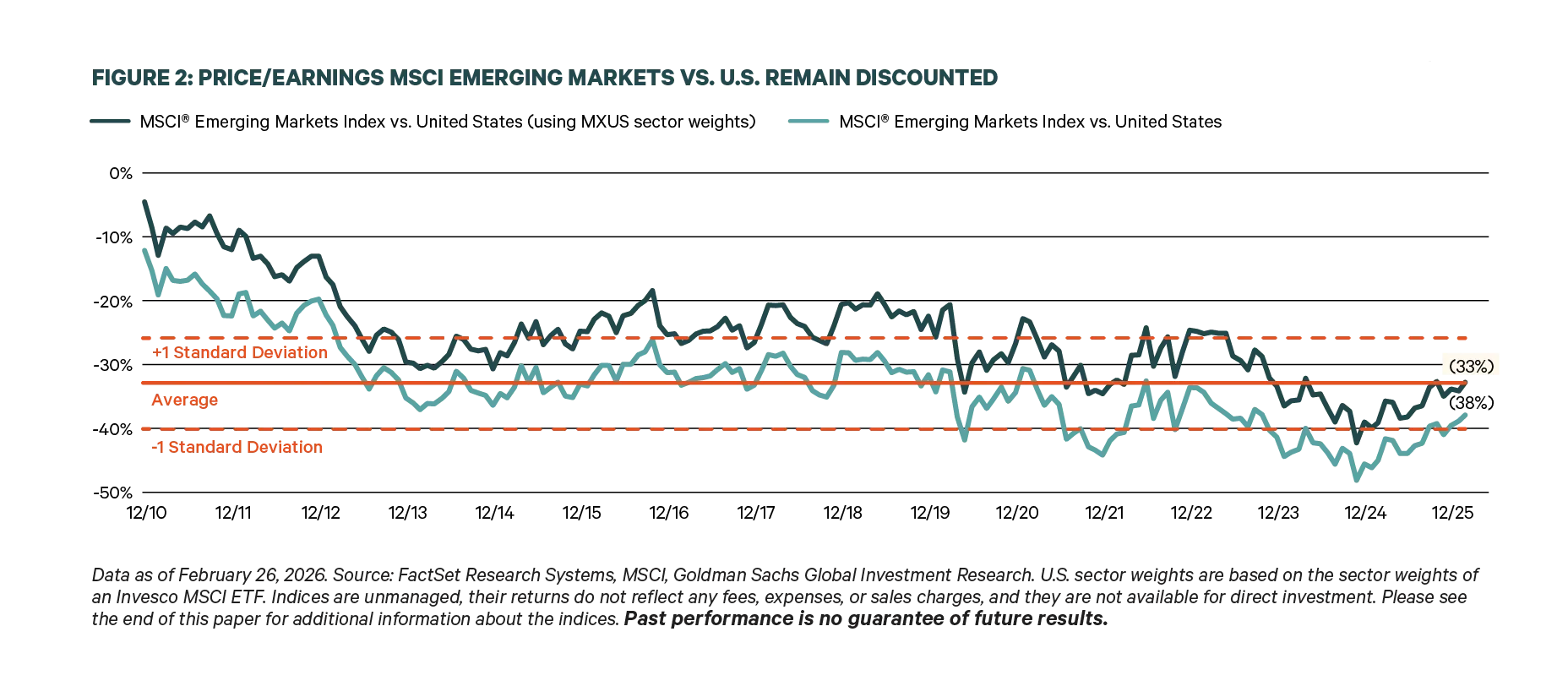
Despite a rally since early 2025, we believe emerging markets valuations remain compelling investment opportunities, as they continue to trade at a deep discount relative to developed markets. This attractive entry point is bolstered by investor positioning, with institutional allocations currently near historical lows and well below benchmark weights.
Why Quality Matters in Emerging Markets Investment
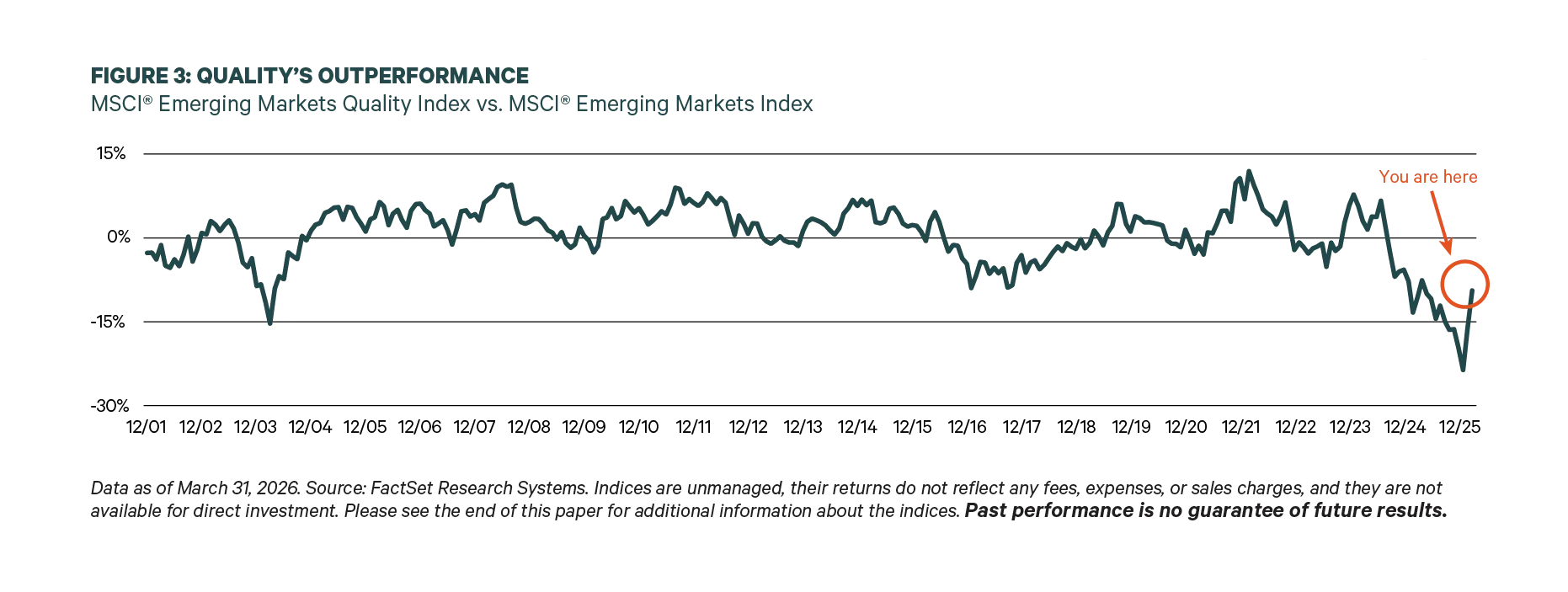
High-quality businesses have historically outperformed within emerging markets over full cycles, but that outperformance is rarely linear. Early in recoveries, more cyclical businesses often lead, but they also tend to experience deeper declines. Avoiding large drawdowns is critical, as losses require disproportionately larger gains to recover. We believe the next phase of the cycle could support a different set of characteristics—businesses with more structural sources of demand, genuine pricing power, and competitive positions that are difficult to replicate. Currently, quality businesses overall do not command the valuation premium they have historically attracted. We believe long-term investors should take advantage of this disconnect.
Quality Stocks Are Out of Favor — and That May Be the Opportunity
Recent emerging markets performance has been driven by cyclical, capital-intensive sectors like semiconductors, technology hardware, and metals and mining. This follows a familiar early-cycle pattern where the most beaten-down or operationally leveraged companies move first and fastest when sentiment improves. Consequently, high-quality businesses—defined by strong returns on equity and stable earnings—are currently out of favor and do not command their typical valuation premiums. From our perspective, this disconnect creates an attractive entry point for emerging markets investment opportunities for long-term investors looking to acquire underappreciated, high-quality assets before the next phase of the cycle.
Why We Believe Active Management Matters in Emerging Markets
As we see it, passive emerging markets investing introduces significant risks, as market-cap weighted indices often lead to high concentration in sectors tied to volatile global narratives and geopolitical risk. Furthermore, these indices must include state-owned enterprises, which are frequently run for political objectives rather than shareholder returns.
That’s why we believe active management in emerging markets is critical. In these inefficient, under-researched markets, there are over 15,000 listed companies, yet only 1,200 are included in major benchmarks. This environment mandates that disciplined active managers avoid poor capital allocations and instead identify high-quality businesses positioned for durable, long-term value creation.
A more comprehensive discussion, including illustrative portfolio examples aligned with our forward‑looking investment framework, is available in the full white paper.