Artificial intelligence may prove to be one of the most consequential technologies of the coming decades. However, as investment in data centers, semiconductors, networking infrastructure, and power generation accelerates, an increasing number of companies and industries have become tied to the same underlying growth driver: AI capital spending. We believe this has created a concentration risk that may be overlooked in portfolios that appear diversified on the surface – including major indices such as the S&P 500 and Nasdaq 100.
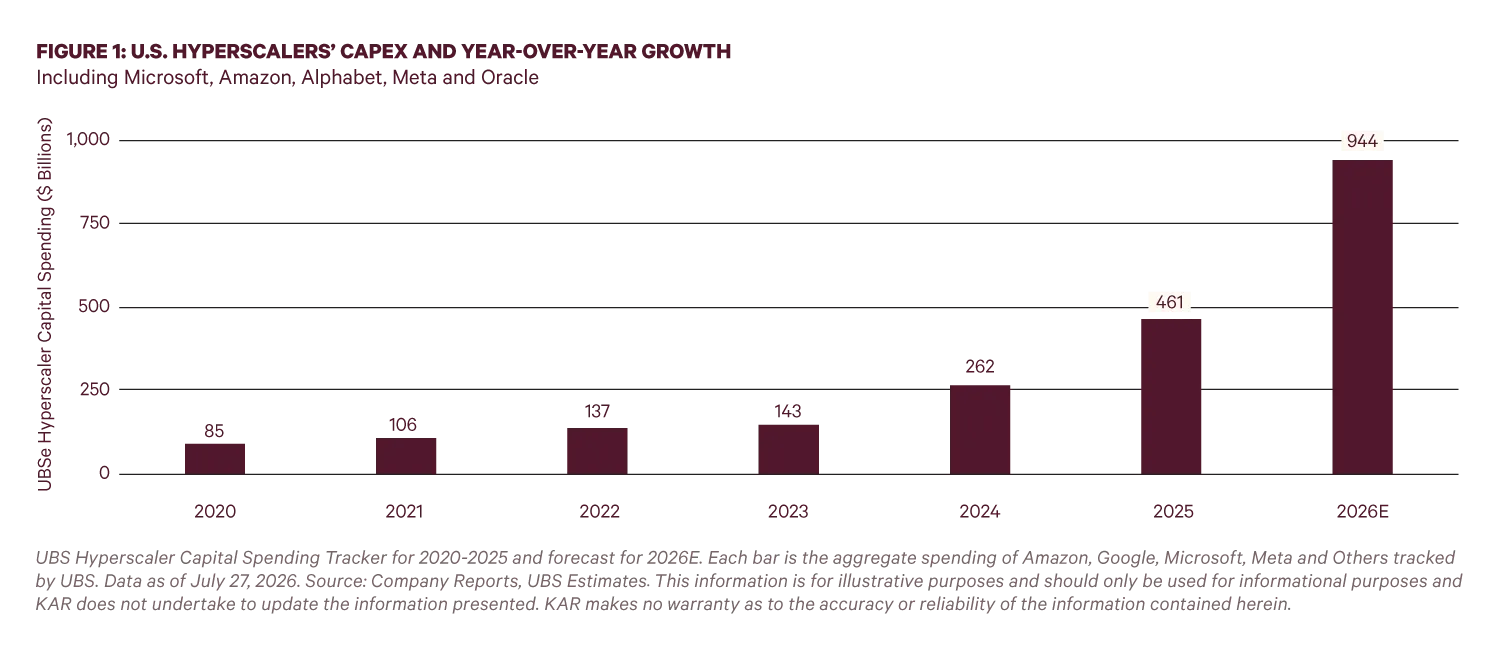
At Kayne Anderson Rudnick, we believe addressing this risk does not require investors to abandon AI. Instead, it requires distinguishing between businesses whose fortunes depend primarily on continued infrastructure buildout and those positioned to benefit from broader, longer-term drivers of economic growth.
Rather than attempting to predict the path of AI infrastructure spending, the KAR Thematic Quality strategy is designed to participate in different sources of long-term growth. The strategy’s differentiated positioning stems from three defining characteristics: a preference for recurring revenue business models, exposure to differentiated structural themes, and ownership of businesses with company-specific competitive advantages.
A Preference for Recurring Revenue
The strategy favors businesses with recurring revenue models, including subscriptions, consumable products, memberships, and other recurring customer relationships. These businesses begin each period with an existing revenue base, making them less dependent on constant new sales to sustain growth. In contrast, many companies benefiting directly from AI infrastructure spending rely on one-time equipment sales and can be more exposed to capital spending cycles.
Exposure to Distinct Structural Themes
Rather than concentrating in the areas of the market most directly tied to AI infrastructure spending, Thematic Quality seeks exposure to durable structural themes that are underrepresented in broad market indices. Current examples include inflation relief, the digital economy, cybersecurity, and critical energy infrastructure. We define these themes as long-term shifts that can reshape industries and create opportunities for high-quality businesses over many years.
One example is the Digital Economy. As commerce continues to migrate online, businesses that reduce friction between buyers and sellers can benefit from increasing transaction volumes and greater economic activity. We believe this trend could become even more important as AI-enabled agents increasingly facilitate commerce on behalf of consumers and businesses. Rather than relying on continued investment in AI infrastructure, these companies may benefit from the broader adoption and practical use of AI across the economy.

AI Exposure Through Usage, Not Just Buildout
Importantly, Thematic Quality is not designed to avoid AI. Instead, the strategy selectively invests in businesses that we believe may benefit as AI adoption expands throughout the economy, rather than solely from the construction of AI infrastructure. We refer to many of these businesses as “AI usage tollbooths” because their growth is linked to increasing use of AI-powered applications, workflows, and digital services. Cybersecurity and digital economy companies are examples of areas where we see this dynamic at work.
Company-Specific Competitive Advantages Matter Most
A compelling theme alone is not sufficient. Thematic Quality focuses on businesses with durable competitive protections, including network effects, cost advantages, switching costs, and advantaged distribution. These company-specific characteristics may allow high quality businesses to stay above the fray of competition – thus maintaining the potential for high profitability and return on capital over time.
The Bottom Line
While AI may remain a transformative force, we believe investors should consider whether their portfolios are becoming increasingly dependent on a single source of growth. Thematic Quality seeks to provide diversification through recurring revenue business models, differentiated structural themes, and competitively protected companies with idiosyncratic growth drivers. In our view, these characteristics offer a distinct approach to participating in long-term growth opportunities while reducing reliance on the continued expansion of AI infrastructure spending.