For most law-firm partners, retirement is the first time in decades when clients’ demands, firm commitments, and billable hours no longer shape your days. In retirement, you will regain time and freedom. But you will also leave behind a familiar structure and a long‑standing professional identity. Many partners naturally find these changes both exciting and disorienting. That is why when it comes to retirement, thinking about the life you want is just as important as thinking about the financial part of the equation.
Approached thoughtfully, retirement becomes an opportunity to reallocate your energy toward relationships, causes, and pursuits that have taken a backseat during your career. A well-conceived plan can help ensure that your money, your time, and your values are all moving in the same direction. When planning for retirement, we believe two overarching considerations should be addressed: where your retirement income will come from, and how you will spend your time.
Replacing Your Paycheck
Recreating a predictable paycheck in retirement means coordinating a mix of firm benefits and personal assets. For many senior partners, income will include firm pensions or retirement benefits and any deferred compensation tied to the partnership or to prior firms. It may also include distributions from taxable investment accounts, retirement accounts, and other savings.
A key planning step is to map out which income sources will turn on and when, how long they will last, and how they will be taxed. Comparing those cash flow projections with your anticipated spending will reveal whether you are on track to fully cover your anticipated lifestyle or will need to adjust timing, savings, or expectations before stepping away.
Prioritizing Your Activities
Income planning only works if it supports the life you desire to live. Retired partners tend to gravitate toward a few broad paths, often in combination. It is common, for example, to continue to work in a limited way, whether as a consultant, mediator, expert witness, or board member. Doing so may help you to stay engaged and provide an intellectual challenge. Retirement may also be the time to finally prioritize passion projects. Teaching, pro bono or nonprofit board work, writing, or building a new venture on your own terms are just a few examples.
Many retirees find they can travel more on their terms. You might take extended trips to the places that intrigue you, visit places you never had the time to explore, or even split living time in multiple locations. For many, retirement provides a welcome opportunity to spend more quality time with family and friends, from extended visits and shared experiences with adult children and grandchildren to being more present in your community. Clarifying these priorities will help to translate a broad retirement estimate into a concrete spending and income plan.
A Retirement Readiness Checklist
As your priorities, risk tolerance, and time horizon evolve, your financial structure should evolve with them. Several areas typically need a fresh look as you transition into retirement.
- Aiming to Reduce Portfolio Risk:
As your priorities, risk tolerance, and time horizon evolve, your financial structure should evolve with them. Several areas typically need a fresh look as you transition into retirement. - Generating Reliable Income:
Your investment portfolio may need to shift from a primarily growth‑oriented stance toward a strategy that can provide sustainable withdrawals, interest, and dividends while keeping pace with inflation. - Coordinating With Firm Benefits:
If a pension or retirement benefit is front‑loaded or time‑limited, your portfolio strategy should anticipate the step‑down in income and build toward filling that eventual gap. - Insurance and Risk Mitigation:
With peak earning years behind you, the role of insurance typically shifts away from replacing future income and toward managing risks related to health, the longevity of your assets, and potential estate conflicts. - Tax Planning:
The loss of partnership income may create a valuable window for proactive tax planning. During years when your marginal tax rate falls, you may have opportunities to:
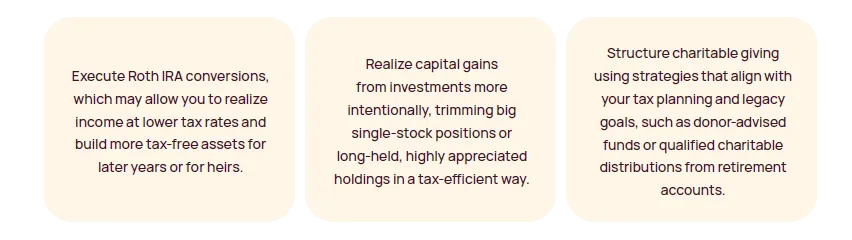
- Estate Planning:
Retirement is often the first point at which the size and structure of your estate are relatively clear, and your children are adults with established paths of their own. That makes this an important time to revisit estate planning. Key questions include:

Integrating these decisions into a long‑term tax roadmap may ultimately help you and your heirs to keep significantly more of your wealth.
How KAR Can Help Retiring Partners Write a Great Chapter
For senior partners, we understand that a successful retirement hinges on weaving financial and personal goals into one coherent strategy. Kayne Anderson Rudnick (KAR) works with law-firm partners and other high‑net‑worth individuals and families on integrated wealth management strategies. Services typically include comprehensive financial planning, investment and income strategy, tax‑aware planning, and estate and legacy guidance. Our work focuses on helping clients design frameworks that support both near‑term transitions and long‑term legacies. In practice that means building a customized plan that can:
- Map your firm’s retirement benefits, your investments, and other assets onto a lifetime cash‑flow strategy that supports how you want to live in retirement.
- Position your investment portfolio with a retirement-appropriate risk profile while still targeting the growth and income you need.
- Identify tax- and estate-planning opportunities in collaboration with your legal and tax advisors, so that the structure of your wealth reflects your values and intentions.
- Provide ongoing monitoring and adjustments as markets, tax law, and your objectives evolve, so your plan stays on track over time.
- Give you a clear picture of your financial life, freeing you to focus more on the relationships and pursuits that matter most to you.
Retirement for senior law firm partners is both a finish line and a starting line. As you conclude your professional journey, you will begin to reshape your purpose and your financial life. We believe that approaching this transition with intention can help you build a retirement that is both financially secure and personally meaningful.
To learn how KAR works with law firm partners on retirement and wealth planning, contact our team.