While much attention has been given to the Magnificent 7 – the seven large cap stocks that have been driving much of the recent growth in the U.S. stock market – we believe there are compelling investment opportunities in U.S. small cap stocks. While investment in much larger companies appears, on the surface, to have such a clear path to gains, we believe small caps can be important drivers of outperformance over a market cycle. Here are four compelling reasons we believe small caps should be getting more attention from investors.
1. Small Caps Should Be a Part of Every Balanced Portfolio
Historically, small cap stocks have generated higher returns than their larger peers over extended periods. That’s because smaller businesses are earlier in their maturation and have more room to grow than larger companies. That being said, we do not believe all small cap stocks are created equal. Because the small cap universe is both large and very diverse in quality, we believe active management is critical to investment outperformance as well as risk management.
2. The Key to Investing in Small Caps Is Being Selective
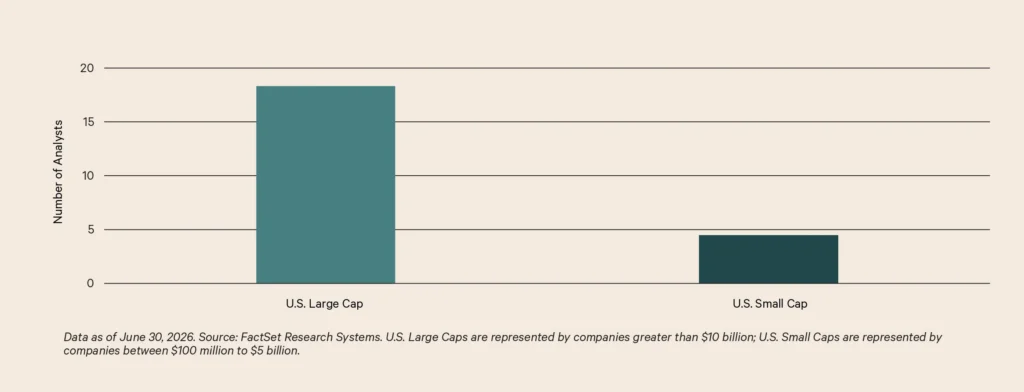
In our view, it’s important to be selective when investing in small cap stocks. Unlike well-known large cap companies, small caps are often businesses the average investor knows nothing about, and they may receive very little Wall Street analyst coverage (Figure 1). As such, they are often overlooked for the larger companies. Because KAR focuses on identifying the qualitative aspects of companies (e.g., durability of a company’s sustainable competitive advantage and management quality), we believe we can seek out small caps that have the potential to endure through multiple business cycles.
FIGURE 1: ANALYST COVERAGE
3. Small Cap Valuations Are Particularly Attractive Right Now
From our perspective, small cap stocks are attractively priced relative to their larger peers as well as their own historical averages. The Russell 2000 Index of small cap stocks is trading at about 15.4 times forward earnings, well below its 10-year average of 16.5 times. Even more significantly, the valuation spread between the Russell 2000 and the large cap-focused Russell 1000 Index is the widest it’s been since the tech bubble burst in the early 2000s. As inflation softens and interest rates decrease, we believe the earnings of high-quality small cap companies will grow at a faster pace than their more well-established large cap peers, creating a significant opportunity for investors in the small cap space.
4. Small Caps Tend to Outperform Large Caps in a Declining Interest Rate Environment
FIGURE 2: RATE CUTS HAVE TENDED TO GIVE THE BIGGEST BOOST TO SMALL CAPS
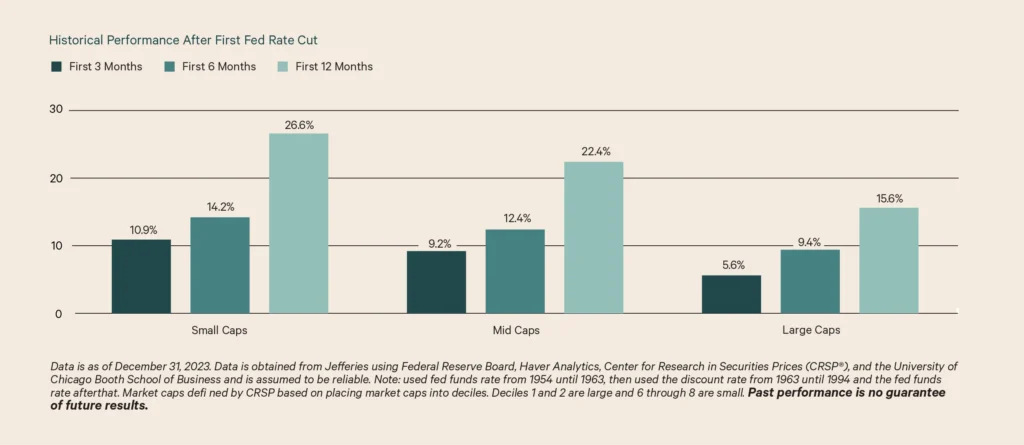
History has shown that as interest rates decline, small cap stocks tend to outperform large caps (Figure 2). That’s because lower borrowing costs are more meaningful for smaller companies than larger ones. Secondly, lower financing costs make it easier for large companies or private equity to acquire these smaller businesses and earn adequate returns. While past performance does not guarantee future results, small cap stocks have tended to perform well relative to large and mid-cap stocks following the first interest rate cut.
We believe small caps should be a part of every portfolio and, in our view, the current valuations of small caps creates a compelling opportunity to make them part of a balanced portfolio without paying the usual premium to do so. Learn more about why small caps make for a compelling investment, and contact Kayne Anderson Rudnick today to explore our small cap strategy offerings.